Reviews and Mentions
__________________
The piece “Losing the Red Queen’s Race” by Mauro Hertig (…) took the direction of a social experiment. At the world premiere of this work commissioned by the Basel Sinfonietta, the tutti orchestra musicians wear black blindfolds – implying a radical state of emergency in and by itself. The “blind” musicians have to follow the unmasked section leaders and imitate their playing: [a] crazy piece that sounded surprisingly harmonious.
— Die Oberbadische – Losing the Red Queen’s Race (2022) – (translated from German) – Review
__________________
A looping sound installation by Swiss composer Mauro Hertig (…) bolsters the eerie atmosphere, playing irritatingly irregular parental “Shhh”s or an insect’s buzzing.
— Artforum – Interrupted Lullabies (2023)
__________________
Heavy metal, Dada, anti-fairy tales, fine poetry – there was no lack of variety on the last day of Eclat festival. Earplugs were already prepared for “Sacrificial G.O.A.T.” by Mauro Hertig (…). In smash and shout booths, the audience was allowed to “let their suppressed anger run free,” which was recorded and transformed into sometimes horror-like sounds by the duo on stage.
— Stuttgarter Zeitung – Sacrificial G.O.A.T. (2024) – (translated from German) – Review
__________________
(…) But it is, in fine, the Swiss Mauro Hertig who creates the moment of this concert- academy, by throwing himself in a theatrical experience, with certainly reduced means but a good dose of humor and invention. (…) funny and well guided, where the singers mingle with the public (Speculum Historiale) without neglecting the beat of the gesture or the requirement of a vocal writing that makes this theater of words a truly musical experience.
— Res Musica – Musique Classique et Danse – The Great Mirror (2019) – (translated from French) – Review
__________________
(…) And then Mauro Hertig’s The Great Mirror for double vocal quartet, based on the encyclopedia of Vincent de Beauvais, which supposedly contains all the knowledge of the world. This totalizing ambition is transcribed in this three-part performance which integrates and combines a great variety of elements with brilliance in its implementation. (…) The abundance of energy, the smiling tone of les Métaboles [choir], taking part in this experiment, are communicative, ensuring this strong moment of the concert.
— Olyrix – The Great Mirror (2019) – (translated from French) – Review
__________________
(…) Tinged with subtle humor, [Hertig’s] abundant inventiveness does not deprive him of a detailed control of the musical discourse.
— Diapason – The Great Mirror (2019) – (translated from French) – Review
__________________
The Swiss composer and sound artist Mauro Hertig finds his inspiration in the park. Perhaps he thought that there was already enough doom and gloom in the history of music, from Don Carlo Gesualdo to Johann Sebastian Bach and György Ligeti’s Requiem. In Mum Hum, Hertig does not start at the end of life, but at its beginning, more precisely: with the imagination of the soundscapes a fetus could be exposed to in the womb. All kinds of verbal and instrumental sounds can be heard in the online radio version. (…) gives an insight into the inspired workshop of Hertig, who was born in 1989 and studied at the Zurich University of the Arts.
— Schweizer Musikzeitung– Mum Hum (2021) – (translated from German) – Article
__________________
In his piece «Mum Hum», Mauro Hertig positions a pair of musicians on each side of a long tin-can telephone. While the musicians on one side play from the score, much as in classical music setup, the other side listens and imitates the sounds from the senders, creating a flow of echoes. As in the children’s game «broken telephone», the melodies of the senders get distorted and falsified until nothing remains but a stream of mumbles and beeps.
Taking inspiration from what an unborn child can hear inside its mother’s womb, «Mum Hum» creates a setting in which one side of the telephone represents the outside world and the other side constitutes the soundscape of the foetus: mumbled speech, muffled melodies. The mother’s body, which both grows and protects the foetus, turns out to be a falsifier of outside sounds, filtering them through layers of skin, fat and liquid before they reach the foetus’s ear. What the unborn child receives is therefore only ever an echo of the outside world.
— Republik – Mum Hum (2021) – (English) – Article
__________________
„The ears open up. The noises start growing. At some point, everyone stops talking. (…) Silence, eavesdropping. One hears the steps on the moist ground and the trousers as they swish while walking. One never hears this during daytime. Far away, a chirr starts and soon covers the whole clearing which now opens up in front of us. Something rings from behind at the edge of the forrest, it crosses the meadow like a ghost light. Right until somebody passes us with a headlamp and a hand bell. Sometimes that is so simple which appeared so mysterious in the dark“
— Südkurier (Germany), – Pawlow (2016) – 23 August, 2016, print only (translated from German)
__________________
„(…) the 25-years old Zurich composer Mauro Hertig had the opportunity to premiere his duo for drum setups. At the core of the interplay between the two percussionists on several membrane instruments and three car brake drums there lies a clearly perceptible pulse, which is constantly being put into question“
— Neue Zürcher Zeitung NZZ – Tempong (2014 ) – 18 June, 2014 (translated from German) – Review
__________________
„(…) Musical accompaniment such as by experimental guitarist Mauro Hertig further opens up the concept of the traditional reading. It becomes obvious that borders are meant to be crossed here“
— Die Tageszeitung taz (Germany) – Stück für Westerngitarre Solo (2013) – 12 January, 2013 (translated from German) – Review
__________________
Portrait Articles / Interviews
__________________
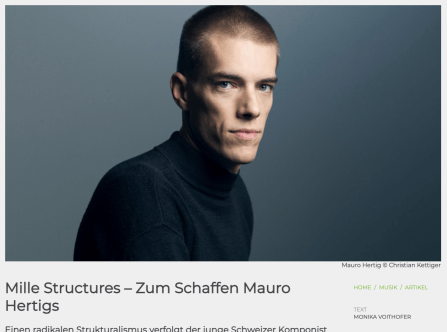
SKUG – Musikkultur
Mille Structures – Zum Schaffen Mauro Hertigs – (1000 Structures – On the Practice of Mauro Hertig) – Monika Voithofer – online, April 2018, German
__________________

VAN Magazin (GERMAN)
“Ich hatte immer das Gefühl, da fehlt was” – (“I always felt like there was something missing”) – Portrait article and interview by Mathias Monrad Møller – Online issue #205, May 2019, German
Read Article
__________________
Blatt 3000 (ENGLISH)
One Should Always Have a Little More Lalala than Blablabla – Portrait interview by Kilian Dumann – 4 pages – print issue #7, February 2017, English
Read Article
__________________

Tank Magazine (ENGLISH)
Safe and Sound – Interview with designer Michael Anastassiades – about sound installation Liquid Contra at London Design Festival Published online, September, 2018, English
Read Article
__________________
Publications as Author
Books

Höranalyse – Neue Werkzeuge der musikalischen Wahrnehmung
(engl: Listening Analysis – New Tools for Musical Perception) German, 112 pages, international print distribution – 2018, Wolke Verlag, Hofheim, Germany
Order Here
__________________
Articles
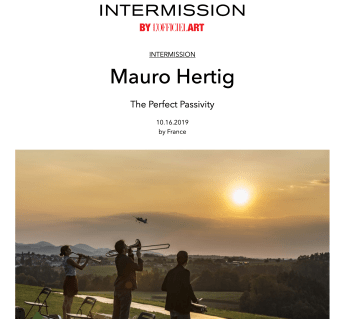
L’Officiel Art Magazine
The Perfect Passivity (ENGLISH) – article about landscape opera Die Perfekte Passivität co-written with Erik Lindman Mata – English, 4 pages, Oct 2019 Intermission Issue – international print distribution & online
ENGLISH Article
Blatt 3000
Applied Abstraction in Analysis (ENGLISH) – print issue #4 Berlin, 2015, Germany
__________________
Online

Founder of Forum of Applied Abstraction – online forum for interactive music analysis combining text with audio excerpts – Contains a collection of phenomenological tools of analysis and applications of those tools in articles on the forum – active since 2015
Forum of Applied Abstraction
 MAURO HERTIG